Astrophysics is an area concerning various physical ranging from planetary sized systems, to galactic scale systems and beyond, that intersects various disciplines such as Newtonian dynamics, relativistic physics and particle physics processes.
For our latest developments/activities in this area, please see the listing below at the end of this article.
Exoplanets
An exoplanet is a planet outside the Solar System. In the Milky Way galaxy, it is expected that there are many billions of planets (at least one planet, on average, orbiting around each star, resulting in 100–400 billion exoplanets), with many more free-floating planetary-mass bodies orbiting the galaxy directly.
We study the long-term dynamics of known multi-planet systems. This allow us to test the accuracy of the orbital parameters' determinations, as well as to understand how these systems evolved. We also look for the stable zones in the gaps between already-known planets in order to determine where is it possible to locate Earth-like planets.
See here a movie made by the PhD Animation on "Exoplanets Explained", for a review on the main observational methods used to detect exoplanets.
Latest Astrophysics Publications
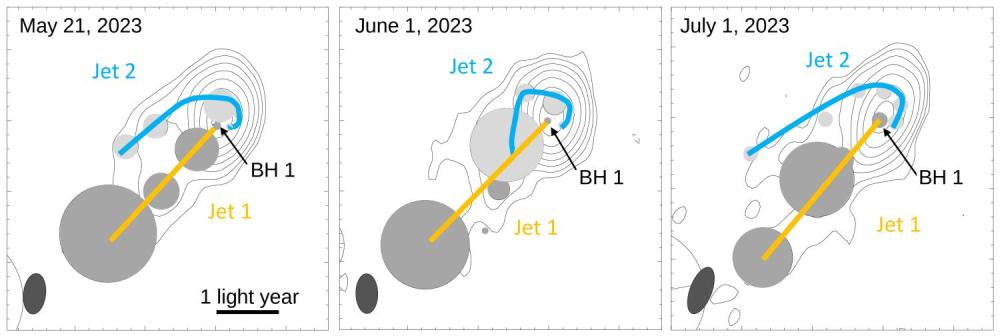
Detection of a second jet within the nuclear core of Mrk 501, S. Britzen, H. Olivares, Gopal-Krishna, F. Jaron, I. N. Pashchenko, E. Kun, F. K. Schinzel, J. Becerra González, D. Paneque, N. R. MacDonald; Monthly Notices of the Royal Astronomical Society (2026) stag291.
Locating the missing large-scale emission in the jet of M87* with short EHT baselines, B. Georgiev et al. (w/ H. Olivares); arXiv:2601.13356 [astro-ph.HE].
Spatially resolved polarization swings in the supermassive binary black hole candidate OJ 287 with first Event Horizon Telescope observations, J. L. Gómez et al. (w/ H. Olivares); Astron. Astrophys. 705 (2026) A23.
I will discuss the first 3D-general relativistic magnetohydrodynamic (GRMHD) simulation of sustained accretion onto a horizonless singularity in which matter falls onto the central object rather than being accumulated outside of it or expelled in outflows.

Oleg Tsupko, an expert in several strong gravity topics including lensing and black hole shadows, joins Gr@v as a CEEC researcher from April 2026. Welcome Oleg!
Our group coordinated the "Numerical Relativity and High Energy Physics" IRSES network (2012-2015). Here is a list of the global network meetings organized: