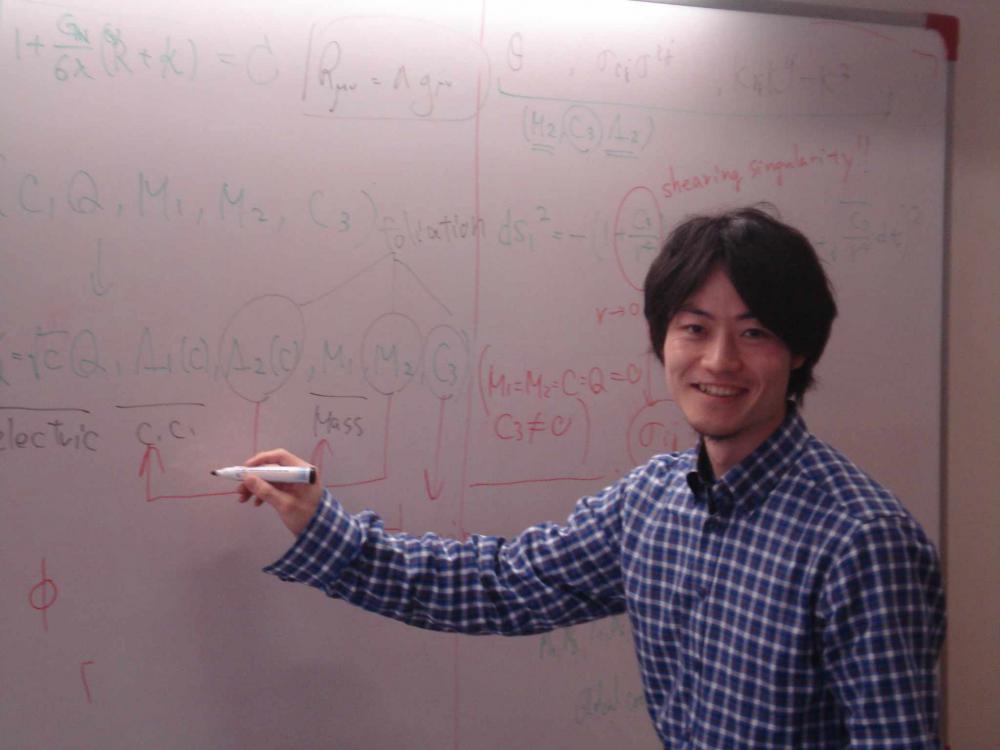
Abstract: n-DBI gravity is a gravitational theory introduced in arXiv:1109.1468[hep-th], motivated by Dirac-Born-Infeld type conformal scalar theory and designed to yield non-eternal inflation spontaneously. I explain that any solution of Einstein gravity with a particular curvature property is a solution of n-DBI gravity.
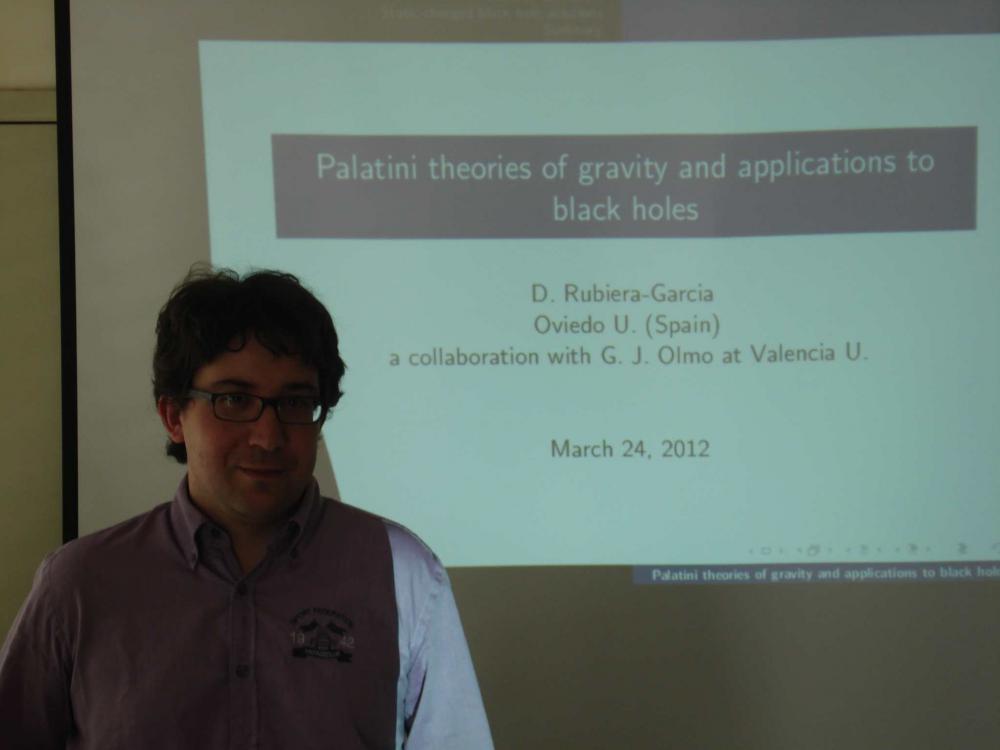
Abstract: We make a broad discussion, both mathematical and physical, of different aspects of Palatini theories of gravity. These theories are defined by the idea that metric and connection are physically independent entities, in such a way that the field equations are obtained by performing independent variations with respect to both of them.
In this short course, we review Dirac's method for dealing with constrained systems in the Hamiltonian formalism, including: primary and secondary constraints, first- and second-class constraints, gauge transformations, and counting of degrees of freedom. Examples and exercises, with particular emphasis on gauge field theories (electromagnetism and gravity) will be provided.
An extra curricular course on "General Relativity, Cosmology and Black Holes" will run throughout the second semester 2011/12. Only basic knowledge of special relativity and Newtonian gravity will be assumed. By default, sessions will take place every friday at 14H00 in the GAP room. Some lecture notes will be handed out and exercises will be set in every session and solved in the following one.
Abstract: We shall review an analytic method, first used by D'Eath (1978), to study high speed collisions of black holes at finite boost, and extract the gravitational radiation.
Abstract: We develop a procedure for models described by one real scalar field in (1+1) dimensions, that makes posible to obtain new models and their static solutions straightforwardly from one known model. The method is illustrated by some applications and extended byp traveling wave solutions of systems described by high-order partial differential equations.
Abstract: Recently we have investigated the wave equation of a massive vector boson, which is governed by Proca field, in the D-dimensional Schwarzschild background. Because the mass term introduce a coupling between two physical degrees of freedom, we have to solve s set of coupled ordinary differential equations.
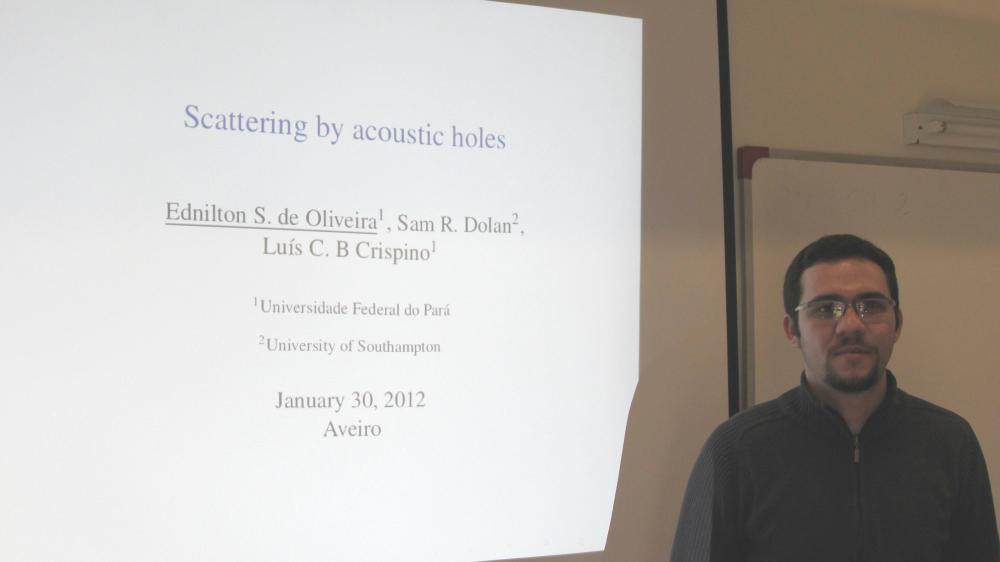
Abstract: Wave scattering by black holes is a subject that has received much attention in the 1970s, and has been extensively studied since then. In this presentation we analyze scattering properties of black hole analogues in acoustic systems. Analogues are artificial systems with some of the key properties of black holes that were proposed by Unruh in 1981.
Abstract: It is well known that D-dimensional vacuum gravity with D-2 commuting Killing vectors is integrable. For such theories a solution generating technique has been available since it was first presented by Belinski and Zakharov in 1978.
Our group coordinated the "Numerical Relativity and High Energy Physics" IRSES network (2012-2015). Here is a list of the global network meetings organized: