XIX Black Holes Workshop
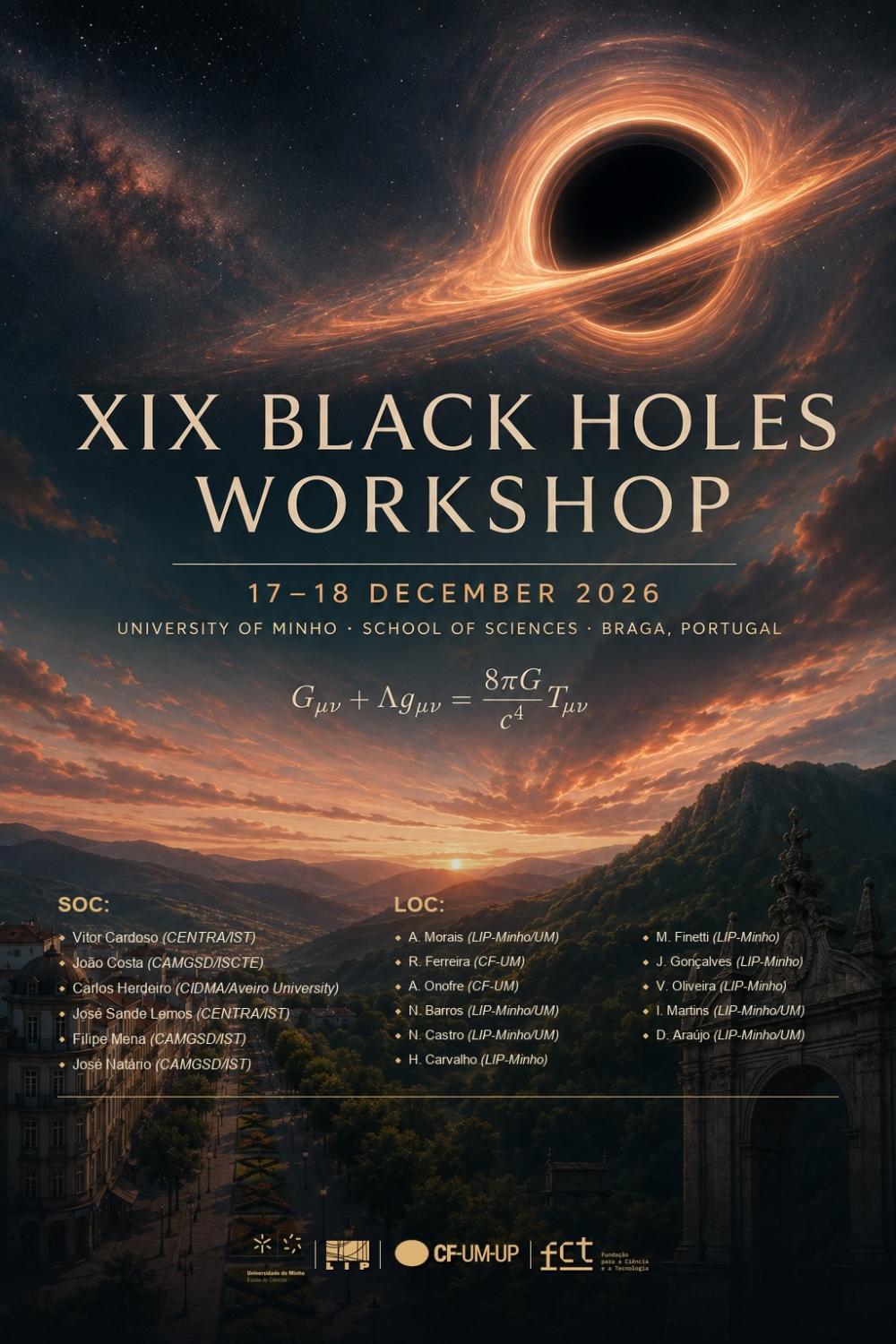
The XIX edition of the Black Holes Workshop will take place at the University of Minho, on 17-18 December 2026. More info here.

Next-generation chemotherapy treatments based on black hole algorithms: From cancer remission to chronic disease management, M. P. Soares dos Santos, R. M. C. Bernardo, J. V. Vidal, A. Moreira, D. F. M. Torres, C. A. R. Herdeiro, H. A. Santos, G. Gonçalves; Comput. Biol. Med. 180 (2024) 108961.
Exploring gravitational-wave detection and parameter inference using Deep Learning methods, João D. Álvares, José A. Font, Felipe F. Freitas, Osvaldo G. Freitas, António P. Morais, Solange Nunes, Antonio Onofre, and Alejandro Torres-Forné; Class. Quant. Grav. 38 (2021) 155010; arXiv:2011.10425 [gr-qc].
SO(2) gauged Skyrmions in 4+1 dimension, Francisco Navarro-Lerida, Eugen Radu, D. H. Tchrakian; Phys. Rev. D (2020) 125014, arXiv:2003.05889 [hep-th].
On the inexistence of self-gravitating soiitons in generalised axion-electrodynamics, C. A. R. Herdeiro and J. M. S. Oliveira; Phys. Lett. B 800 (2020) 135076, arXiv:1909.08915 [gr-qc].
On the inexistence of solitons in Einstein–Maxwell-scalar models, C. A. R. Herdeiro and J. M. S. Oliveira; Class. Quant. Grav. 36 (2019) no.10, 105015, arXiv:1902.07721 [gr-qc].
The XIX edition of the Black Holes Workshop will take place at the University of Minho, on 17-18 December 2026. More info here.
A four months grant for a student enrolled in a doctorate programme is open, to start on June 1st 2026. More informations here.
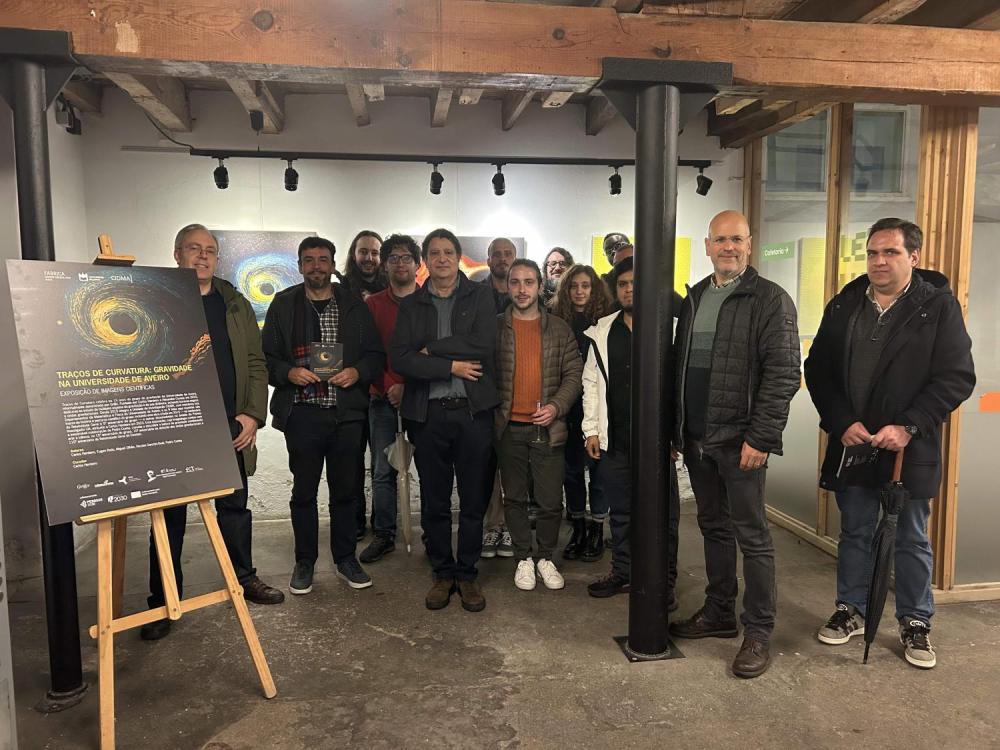
On January 20th, 2026, the art–science exhibition was officially (re)opened at Fábrica - Centro Ciência Viva de Aveiro. The event was hosted by Fábrica’s director, Pedro Pombo, and brought together the head of the Department of Mathematics, Alexandre Almeida, and the director of CIDMA, Delfim Torres, along with several colleagues. This initiative is another step in sharing the beauty of science with a broader audience, strengthening the connection between scientific research and society.
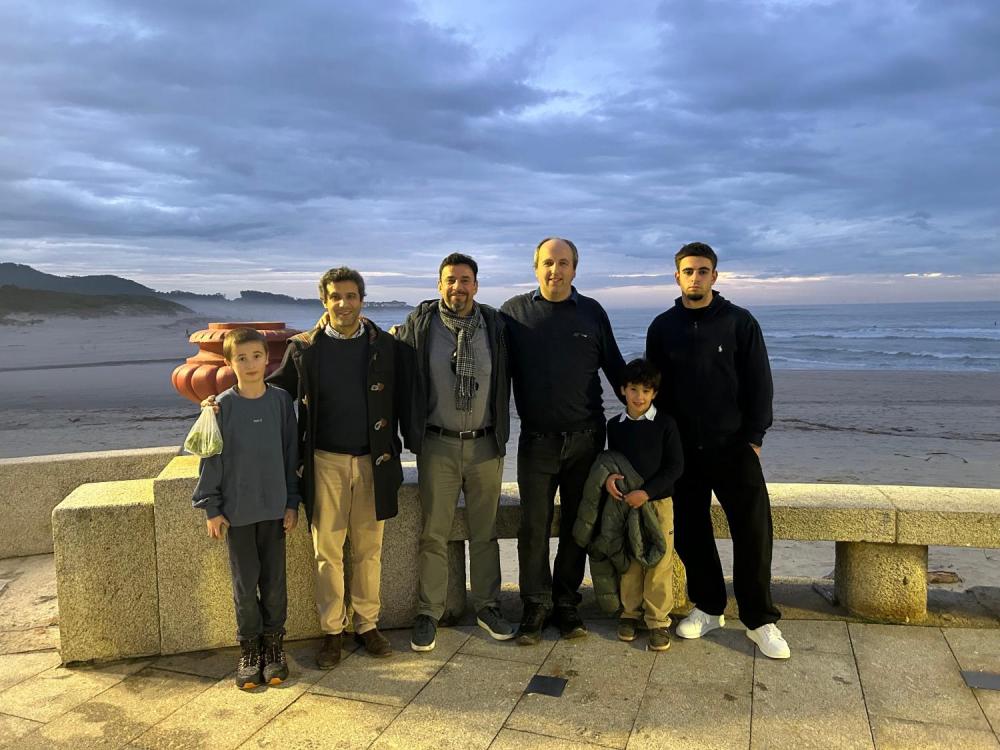
We kicked off 2026 with a get-together alongside collaborators Roman Pasechnik and Antonio Morais. A special highlight: the next generation joined in as well - future scientists already in the making!