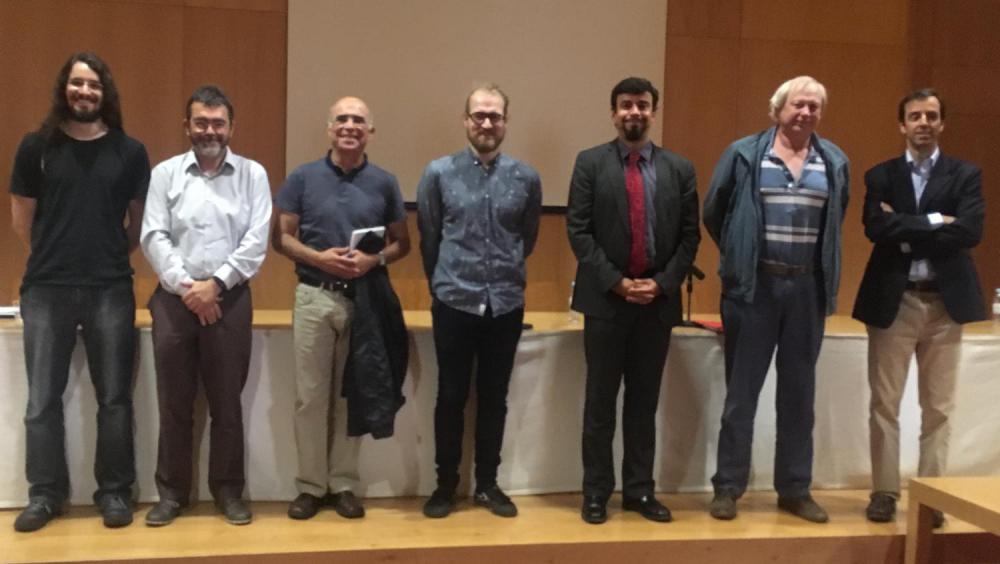
Helgi Rúnarsson successfully defended his PhD thesis "Kerr black holes with scalar and Proca hair". The exam took place at the University of Aveir, on October 9th 2017. The thesis was supervised by Gr@v members C. Herdeiro and E. Radu and former member J. C. Degollado, now at UNAM (Mexico). Congratulations Helgi!
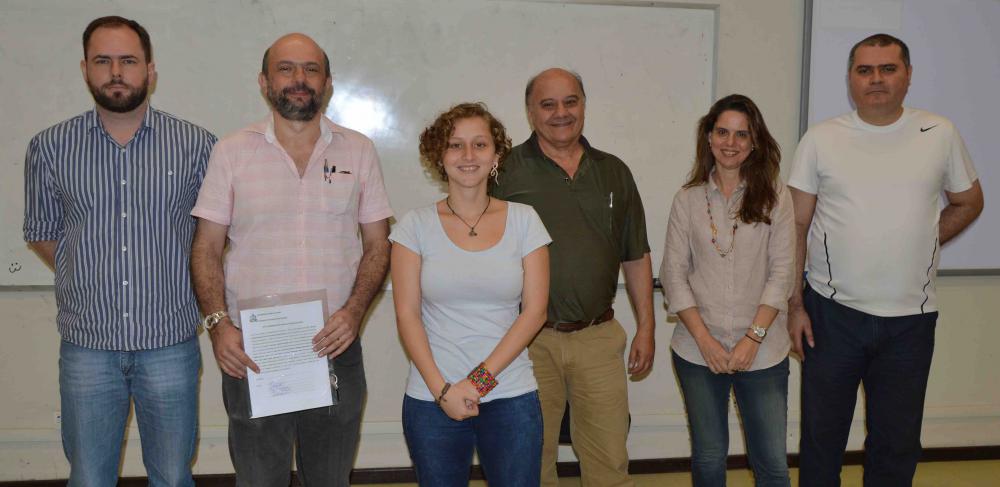
Carolina Benone successfully defended her PhD thesis "Scalar fields in black hole spacetimes and analogues". The exam took place in U. Federal do Pará, in Belém, Brazil, on July 14th 2017. The thesis was supervised by Luis Crispino (UFPa) and Gr@v member C. Herdeiro. Congratulations Carolina!
"90 seconds of Ciencia" is a daily programme of the National Public Radio, Antena 1. Hear in this link the contribution of Gr@v researchers to this excellent show that makes accessible to a larger audience the research made in Portugal, across all fields of knowledge.
Abstract: The hierarchy problem and the irreconcilability of quantum mechanics and general relativity are two of the most frustrating problems that the Standard Model fails to solve. The existence of extra dimensions, however, would provide the much awaited solutions. If extra dimensions exist and push the Planck scale down to the TeV range, signatures of extra dimensions could be found at the Large Hadron Collider in Geneva, Switzerland. Results of TeV-scale gravity searches with the ATLAS and CMS detectors at 13 TeV are summarized, and outlook is provided on the best way forward in the absence of discoveries.
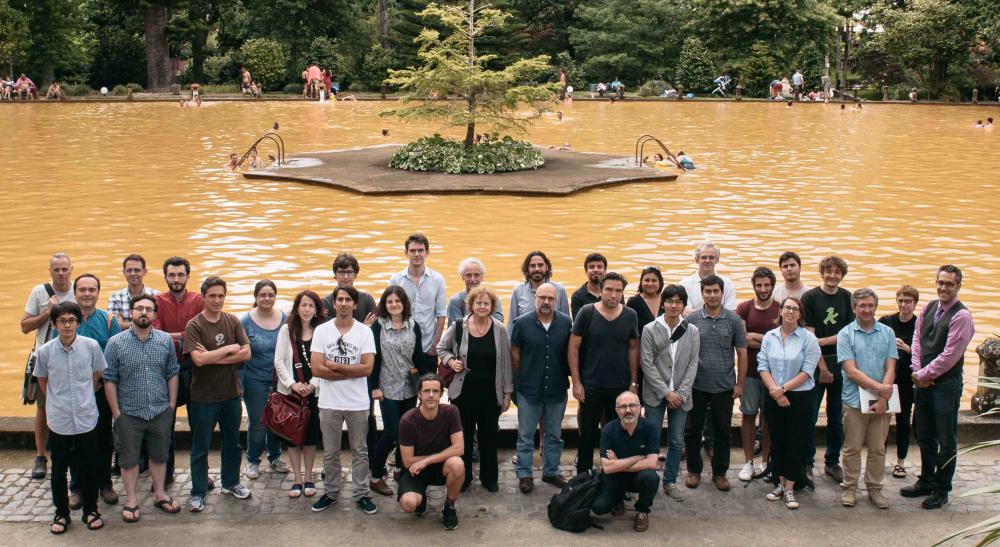
Our group coordinated the "Numerical Relativity and High Energy Physics" IRSES network (2012-2015). Here is a list of the global network meetings organized:

 Position: Long term research fellow - CEEC Junior research position (6 years)