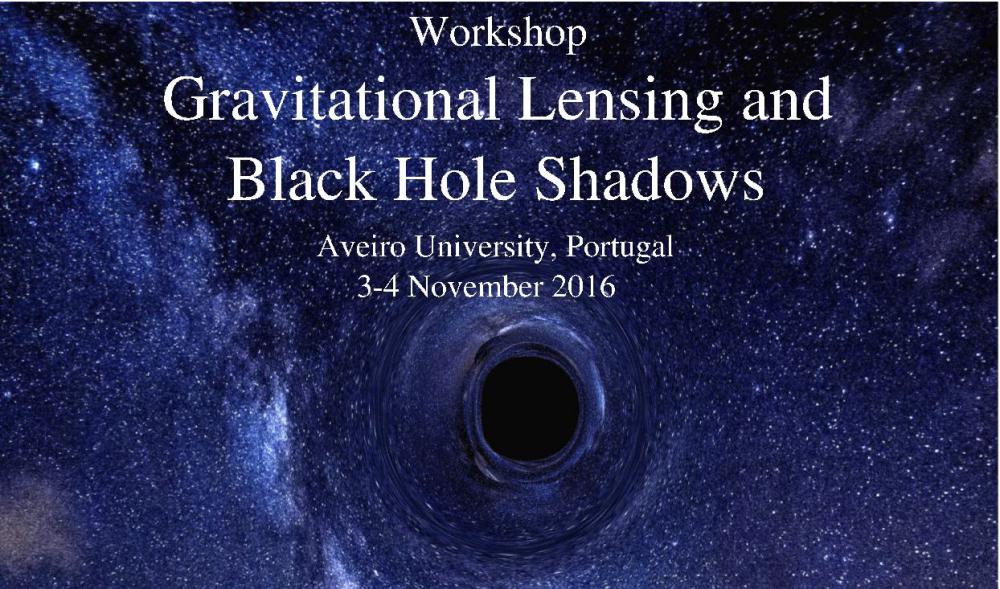
In the wake of the detection of gravitational waves from black hole mergers and at the door step of an era of precision electromagnetic observations of the horizon scale for black hole candidates, in particular with the Event Horizon Telescope, the gravitation groups at Aveiro University, Gr@v, and at IST-Lisbon, Grit, will organize a two days workshop on Gravitational Lensing and Black Hole Shadows, held at the University of Aveiro (Portugal), on the 3rd and 4th of November 2016.
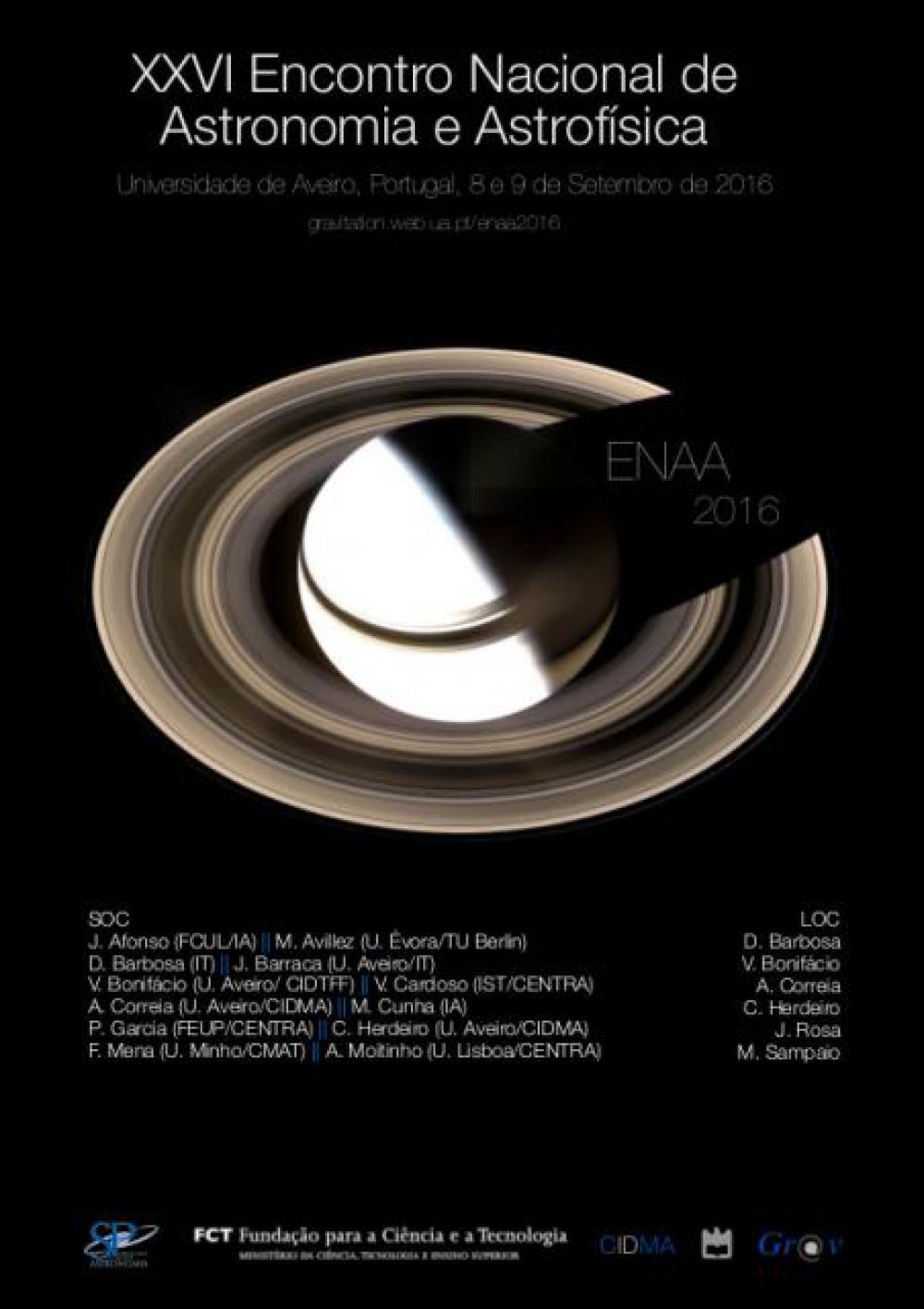
The XXVI National Meeting of Astronomy and Astrophysics will take place at the University of Aveiro, on the 8th and 9th September 2016. This meeting is organized by the Department of Physics of the University of Aveiro and the Center for Research and Development in Mathematics and Applications (CIDMA), in partnership with the Portuguese Astronomy Society (SPA).
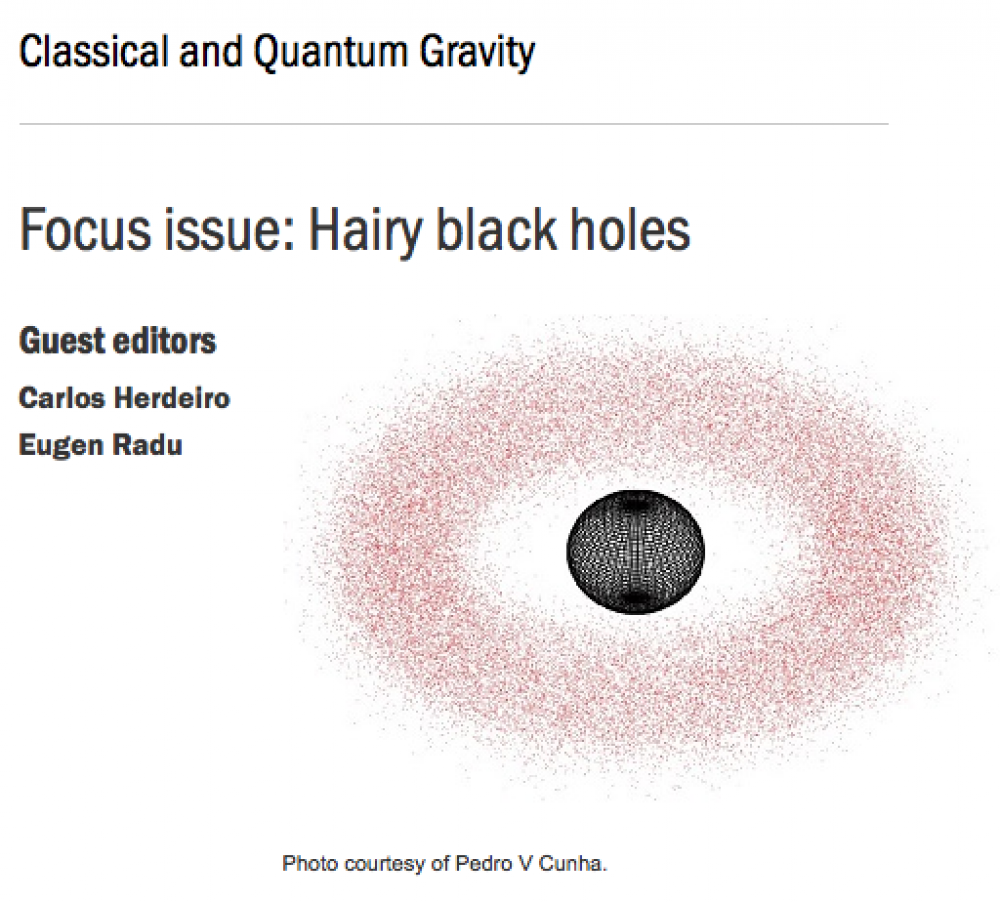
The awakening of the gravitational astronomy era, together with the ever increasing precision of electromagnetic observations, motivates scrutinizing models of alternative compact objects and their phenomenology. As a contribution to this effort, Gr@v researchers will be guest editors of a Focus issue of Classical and Quantum gravity on hairy black holes.
Abstract: In this talk, I will first discuss the challenges one faces when trying to explain the observed late-time acceleration of our Universe, due to the obstacles which the yet unkown physics of dark energy and dark matter place when we try to understand the true theory of gravity at large scales. In this context, I will further explain how model-independent observables have the potential to reveal whether gravity is truly modified at large scales, and will describe a fundamental, underlying relation between large-scale modifications of gravity and the (non-trivial) propagation of gravitational waves, as well as its observational implications for cosmology and astrophysics.
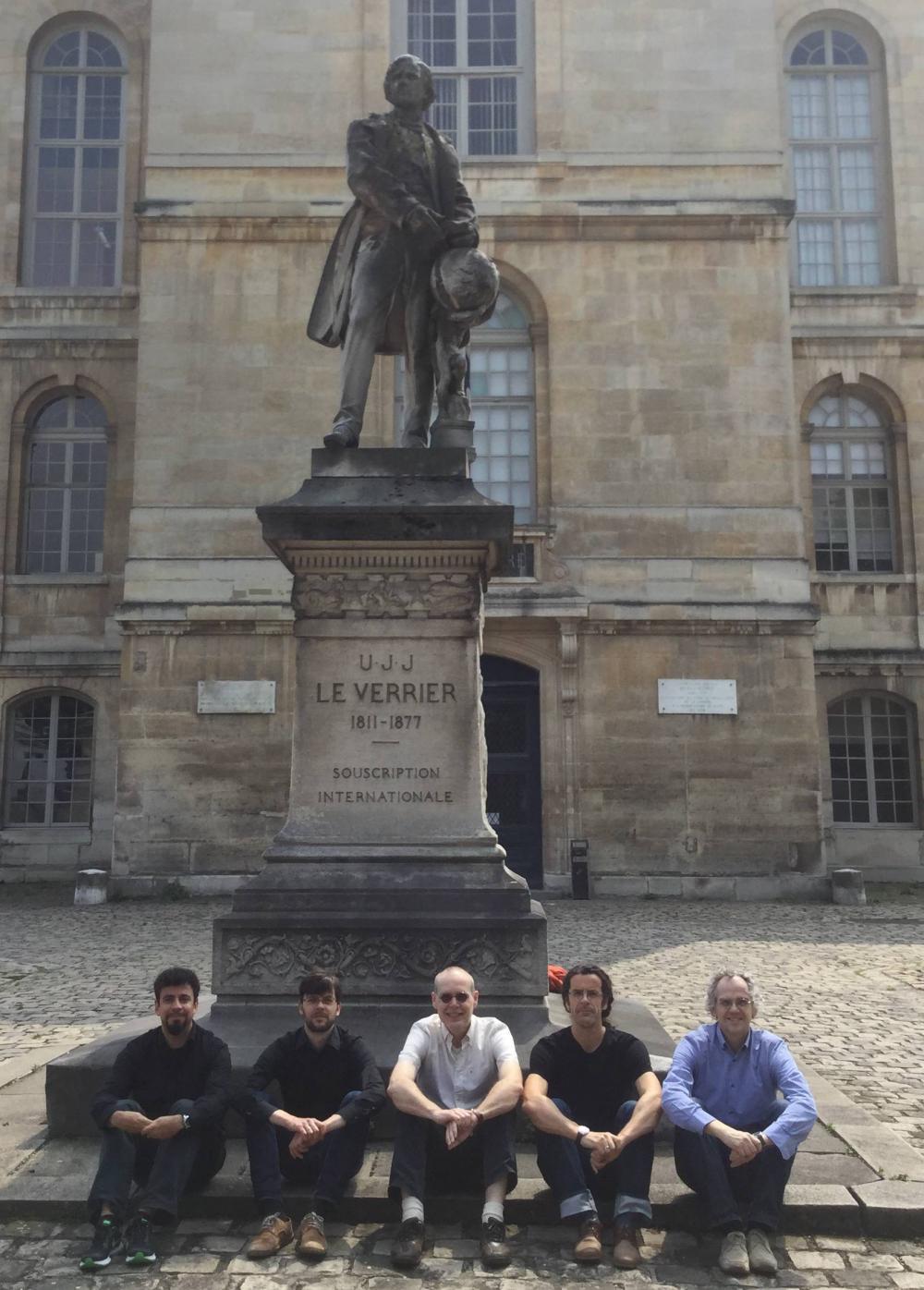
The kick off meeting of the RISE network StronGrHEP, took place on May 12th-13th 2016, in the Institut d'Astrophysique de Paris. Photo: the coordinates of the five European nodes, C. Herdeiro, E. Barausse, U. Sperhake, V. Cardoso and L. Gualtieri by the statue of the great Urbain Le Verrier.
Abstract: I will present my main research topics on transiting exoplanets. I will star by exemplifying the discovery of exoplanets from the K2 mission. I will present the K2 pipeline and show how we find candidates that are later confirmed with follow-up observations.
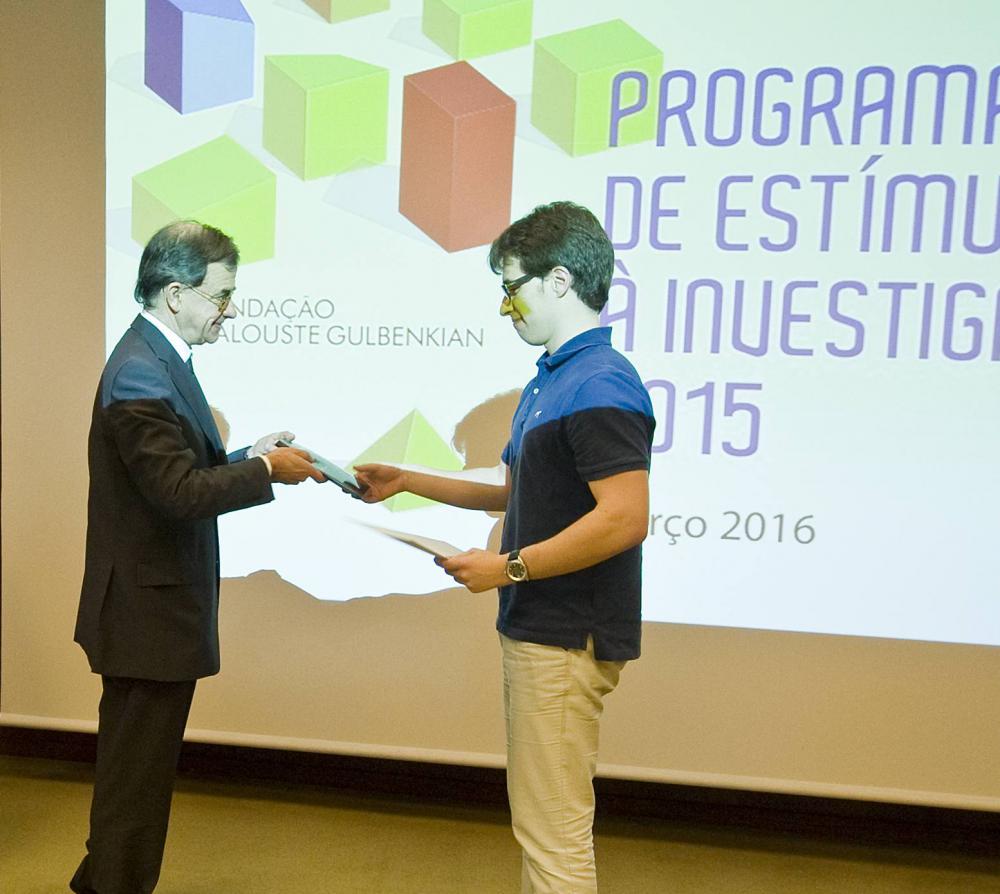
The ceremony for distinguising the recipients of the 2015 Gulbenkian Prizes for Stimulus of Research, took place on March 9th 2016, at the Gulbenkian Foundation, in Lisbon. Pedro Cunha was awarded one of the prizes for his project on "Black Hole Shadows".
Abstract: The ESO/GRAVITY is an adaptive optics and fringe tracker assisted K-band interferometric spectrograph. The instrument development started in the last decade and reached first fringes with the auxiliary telescopes in December 2015.
Our group coordinated the "Numerical Relativity and High Energy Physics" IRSES network (2012-2015). Here is a list of the global network meetings organized: