The Gr@v research group invites expressions of interest from researchers wishing to apply to the forthcoming 9th edition of the Individual Call to Scientific Employment Stimulus (CEEC Individual), funded by the Portuguese Foundation for Science and Technology (FCT).
The CEEC Individual programme offers competitive funding for three-year research contracts, providing an opportunity for talented researchers to develop their scientific careers in Portugal.
Carlos Herdeiro, Gr@v member and founder, took office on 1 October as the new Scientific Coordinator of CIDMA, beginning a four-year term. The new coordination team also includes Natália da Costa Martins, Maria Elisa Carrancho Fernandes, and Nelson Filipe Loureiro Vieira. UA News coverage here. We wish the team every success in this new chapter.
We present an Ernst-like formalism for stationary and axisymmetric Einstein–Maxwell/ModMax gravity coupled to a scalar field. The Maxwell sector is recovered as a particular limit of the ModMax theory, allowing both theories to be studied within the same framework.
Gr@v member Héctor Olivares has been awarded a Mexican Diaspora Research Chair ("Cátedras de la Diáspora Mexicana"), a grant supporting Mexican researchers living abroad who wish to maintain academic links with Mexico. The initiative provides annual mobility support for research, teaching, and academic training activities at Mexican higher education institutions and public research centers.
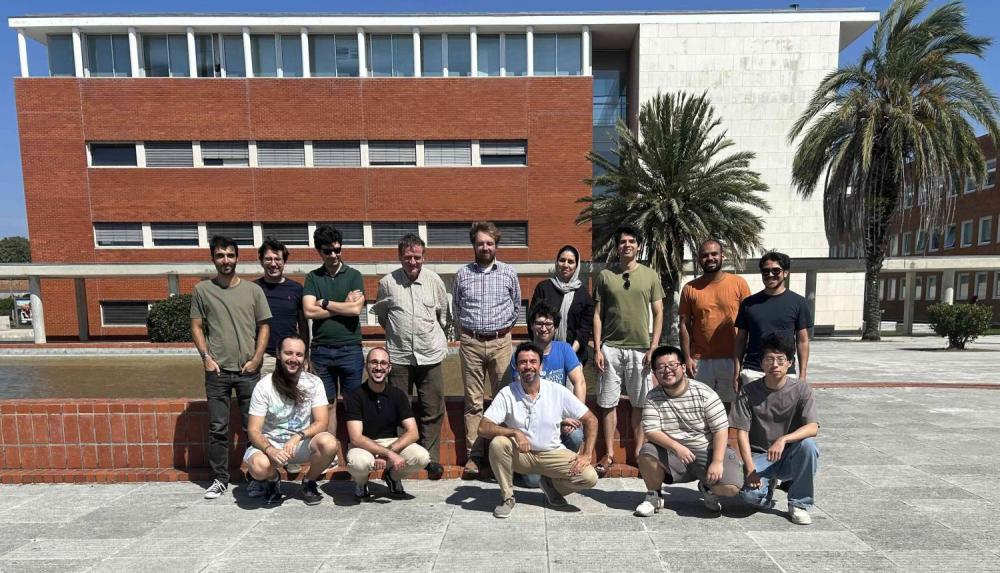
On 16 September 2026, Gr@v resumed its scientific activities with the first Journal Club of the new term. We are delighted to welcome several visitors to the group, including Alvaro Salazar (Valladolid, Spain), Kelvin Alves (UNESP, Brazil), Flavio Rosales Infante (UMSNH, Mexico), and Razieh Ranjbar (Institute for Research in Fundamental Sciences, Iran). We are also very happy to welcome our new PhD student, Yusheng He, who joins us after graduating in China. It is great to see the group growing and our scientific activities getting underway again.
Our group coordinated the "Numerical Relativity and High Energy Physics" IRSES network (2012-2015). Here is a list of the global network meetings organized: