Abstract: The natural laboratories for testing the strong-field regime of gravity and for testing the modified gravitational theories are the neutron stars. In my talk I will present some results about neutron stars, both static and rotating, in f(R) theories and in scalar-tensor theories of gravity. Especially I will focus on effects in modified gravity neutron stars that drastically change the structure of the stars in comparison with General Relativity.
Abstract: We consider the possibility of multiply-connected spacetimes, ranging from the Einstein-Rosen bridge, geons, and the modern renaissance of space-time tunnels/wormholes.
Gr@v Ph.D. student Flávio Coelho successfully defended his Ph.D. thesis with title "Radiadion from a D-dimensional collision of gravitational shock waves" on February 20th 2015. Congratulations Flávio!
Abstract: In this talk I review a recent solution generating technique based on the symmetries of the dimensionally reduced Lagrangian of the Einstein-Maxwell-dilaton system in five dimensions.
Abstract: Recently it has been realized that subleading corrections to soft theorems in gauge theories and gravity are related to the asymptotic symmetries of the theory at null infinity. In this talk I will discuss how in the case of the soft graviton theorem these corrections, when written in terms of kinematic invariants, exhibit a double copy structure for the emitted graviton. This result holds also in the Gribov limit, where emitted gravitons are not necessarily soft.
A large review paper, "Testing General Relativity with past and future Astrophysical observations", arXiv:1501.07271, has been made public, prepared as a Topical Review for CQG. The review includes contributions from many international experts, including from our group, and was led by Emanuele Berti. Thank you Emanuele for pushing this team effort!
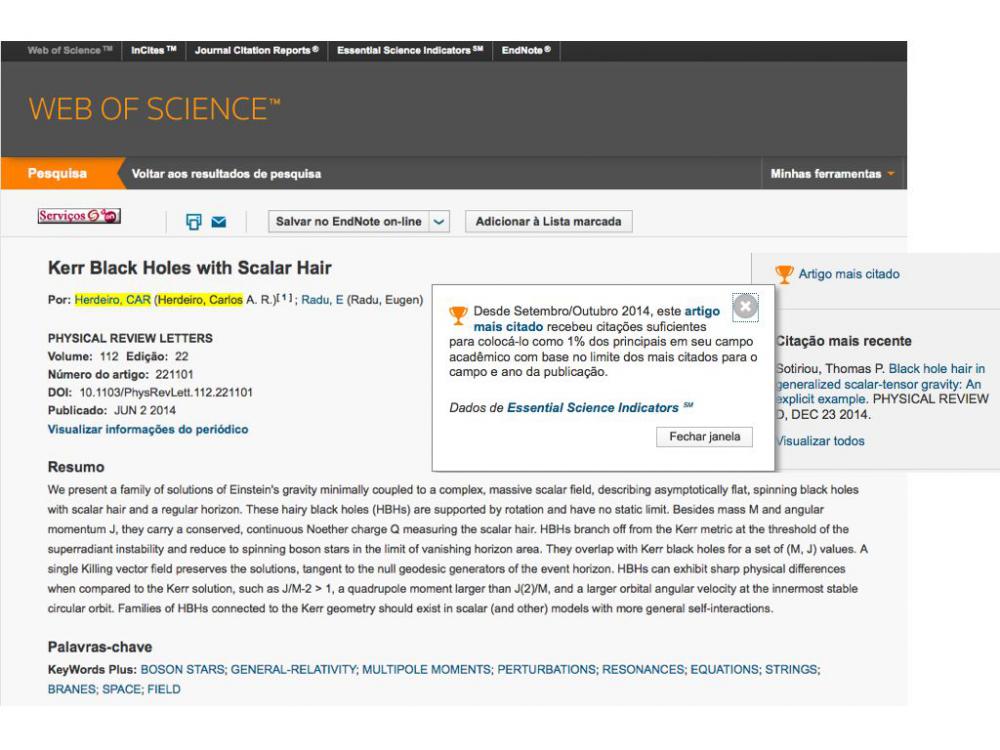
Here, the numerical data described in the paper "Construction and physical properties of Kerr black holes with scalar hair", arXiv:1501.04319 [gr-qc], is made available for public use.
This paper is an invited contribution to the Focus Issue on "Black holes and fundamental fields" to appear in Classical and Quantum Gravity, Edited by Paolo Pani and Helvi Witek.
Our group coordinated the "Numerical Relativity and High Energy Physics" IRSES network (2012-2015). Here is a list of the global network meetings organized: