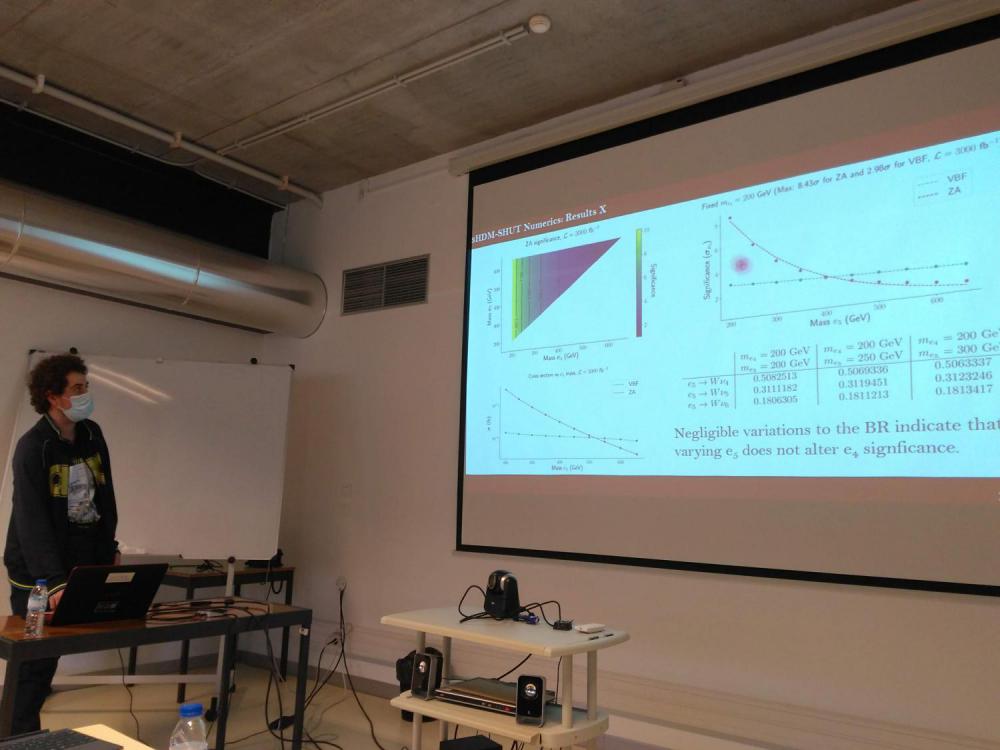
Gr@v in national TV
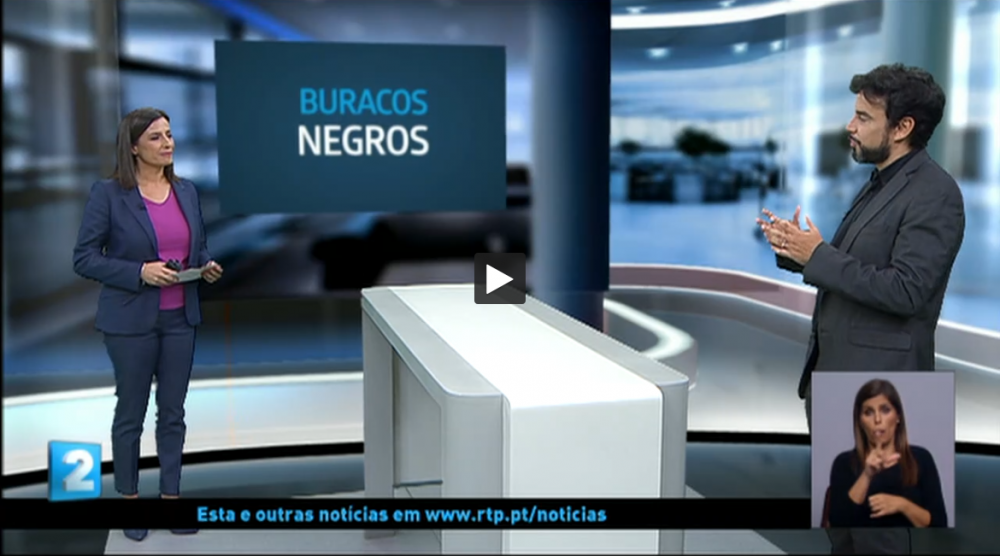
C. Herdeiro was one of the guests of Jornal 2, of RTP2, on October 6th, to talk about the Physics Nobel prize 2020. See the interview here (from 19:52 onwards).

C. Herdeiro was one of the guests of Jornal 2, of RTP2, on October 6th, to talk about the Physics Nobel prize 2020. See the interview here (from 19:52 onwards).
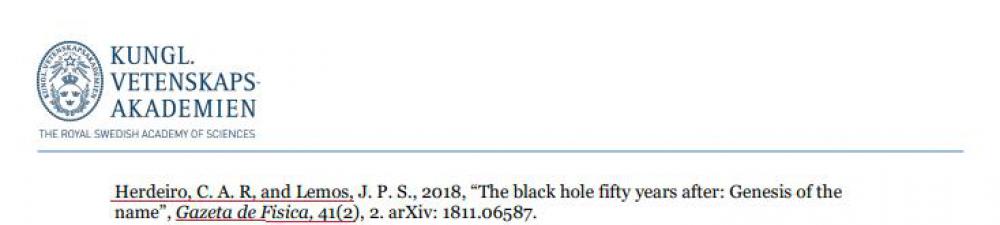
The Scientific background document on the 2020 Nobel Physics Prize mentions the paper by C. Herdeiro and José S. Lemos (from IST Lisbon) on the genesis of the name "black hole" available in the arXiv (in English) and originally pubished in "Gazeta de Física" (in Portuguese).
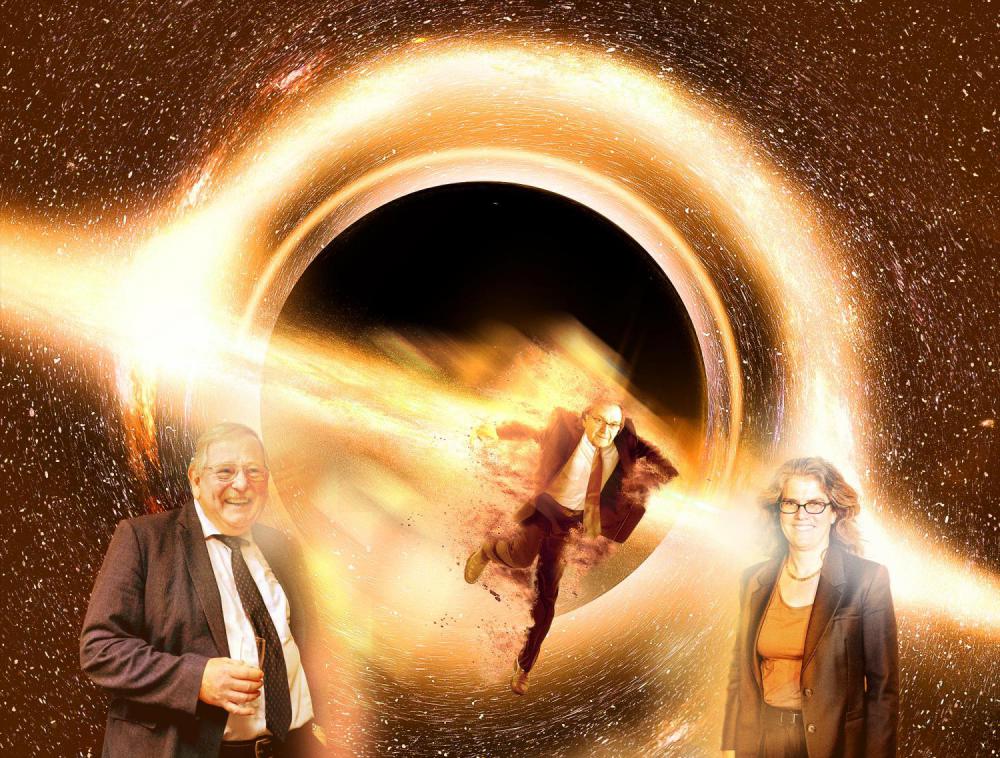
The Nobel Prize in Physics 2020 was divided, one half awarded to Roger Penrose "for the discovery that black hole formation is a robust prediction of the general theory of relativity", the other half jointly to Reinhard Genzel and Andrea Ghez "for the discovery of a supermassive compact object at the centre of our galaxy." Our group is thrilled by this recognition of Black Hole science by the Nobel Committee and heartly congratulates Roger, Reinhard and Andrea!
Neutron stars provide an exciting field of study, not only for the many open questions regarding their inner composition, but also for some of the most puzzling astrophysical phenomena observed in Na

A call for a research grant in the fields of strong gravity/particle physics, for a M.Sc. holder, is open until October 13th 2020. See the call in the attached file or in the eracareers portal.

A call for applications for two post-doctoral positions under the research grant PTDC/FIS-OUT/28407/2017 (PI C. Herdeiro) are open until September 30th. See the Eracareers call here and also attached (in Portuguese).
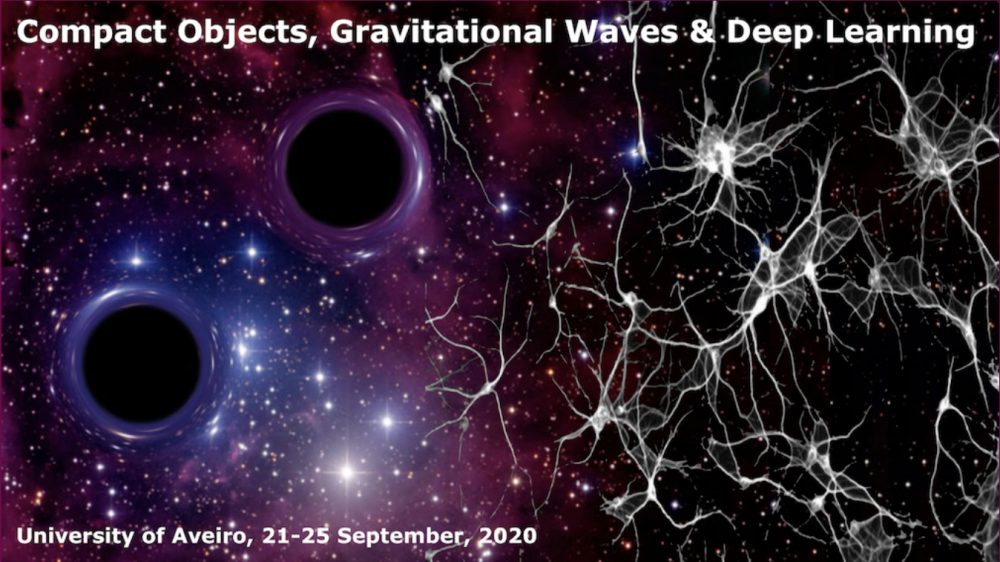
A small Workshop on Compact Objects, Gravitational Waves and Deep Learning will take place at the University of Aveiro (Mathematics Department) from Sep. 21-25, 2020. More info here.
CIDMA has an open call for two junior researchers for the period 2020-2023. Candidates should hold a Ph.D. in Mathematics or related areas (the scientific areas of Gr@v are elegible). The application period closes on Aug 5 2020.
The U. Aveiro Research Summit took place on 24-26 June 2020. Our group contribute with four student pitches (by A. Pombo, J. Delgado, L. Ventura and J. Oliveira). This year's edition of the Reseach@UA magazine included one Gr@v article as a 2019 reseach highlight and two Gr@v papers in the top 10 cited papers (2014-2019).