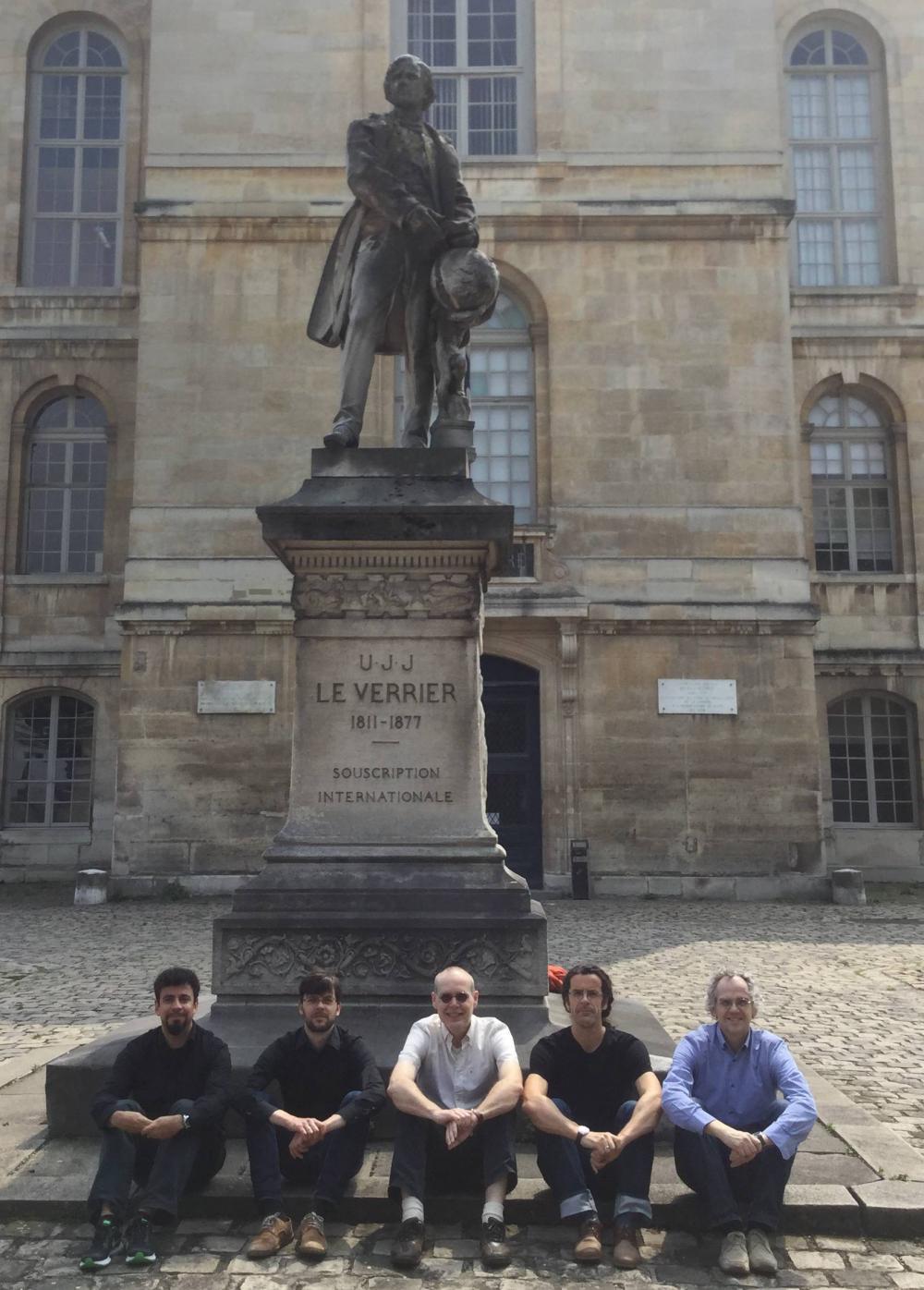
The kick off meeting of the RISE network StronGrHEP, took place on May 12th-13th 2016, in the Institut d'Astrophysique de Paris. Photo: the coordinates of the five European nodes, C. Herdeiro, E. Barausse, U. Sperhake, V. Cardoso and L. Gualtieri by the statue of the great Urbain Le Verrier.
Abstract: We consider models with an extended Higgs sector and look for signals at the LHC. By looking at a combination of three decays, involving the 125 GeV Higgs boson, the Z boson and at least one more scalar, an indisputable signal of CP-violation arises. We use a complex two-Higgs doublet model as a reference model and present some benchmark points that have passed all current experimental and theoretical constraints, and that have cross sections large enough to be probed at LHC during run 2
Gr@v's Ph.D. student Mengjie Wang successfully defended his doctoral thesis with title "Quantum and classical aspects of scalar and vector fields around black holes", on February 29th 2016. Mengjie integrated the MAP-Fis Ph.D. programme and was supported by a grant from the IDPASC doctoral programme. Congratulations Mengjie!
Abstract: The DGLAP evolution scheme offers a description of the reality which might be inaccurate at very small-x. One way to look for alternative evolution schemes, which might be able to describe that region, is looking simultaneously in the forward and central activity in the detector.
Gr@v is a partner of the recently approved "Strong Gravity and High Energy Physics" Marie Curie RISE (Research and Innovation Staff Exchange) action, within the Horizon 2020 European framework. This network has a lifetime of 4 years, starting in Jan 2016 and connects 8 nodes in 7 countries, being coordinated by Prof. Ulrich Sperhake and Cambridge University.
Our group coordinated the "Numerical Relativity and High Energy Physics" IRSES network (2012-2015). Here is a list of the global network meetings organized: