Celebrating the international day of Mathematics, March 14th, which is also Einstein's birthday, C. Herdeiro gave an outreach talk in the Maths Dept. of Aveiro on "Pi and Einstein: from the Universe of Geometry to the Geometry of the Universe". It can be seen here (in Portuguese).
Within the context of the European COST Action GWverse, the community has sumarized the state of the art and propects for the future in a comprehensive roadmap: Black holes, gravitational waves and fundamental physics: a roadmap. The GWverse roadmap, co-authored by our group, has been selected by the Editorial Board of Classical and Quantum Gravity (CQG) as one of the journal's Highlights of 2019-2020.
A “time”-covariant Schrödinger equation is defined for the minisuperspace model of the Reissner–Nordström (RN) black hole, as a “hybrid” between the “intrinsic time” Schrödinger and Wheeler–DeWitt (WDW) equations. To do so, a reduced, regular, and “time(r)”-dependent Hamiltonian density is constructed, without “breaking” the re-parametrization covariance r=f (˜r).
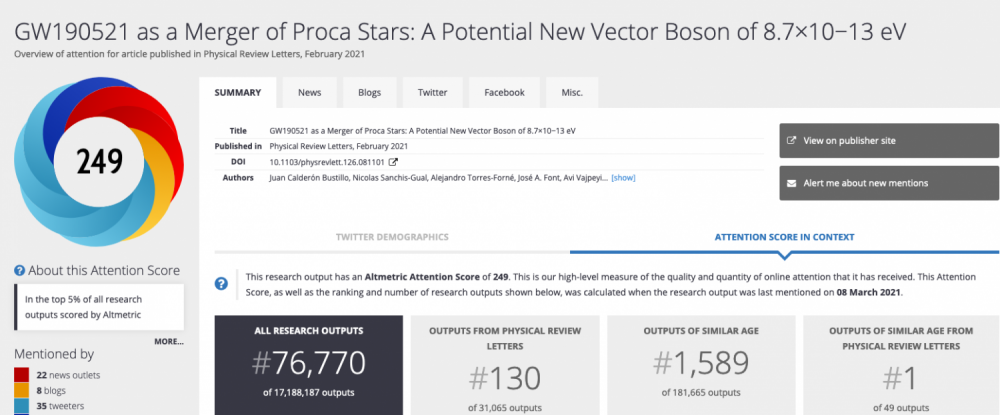
A recent Gr@v co-authored article is ranked #130 in all time media coverage of Phys. Rev. Lett. outputs. Watch here (in English) and here (in Portuguese) video explanations of the work.
The machine learning work by Gr@v member Felipe Freitas for detecting gravitational waves was awarded a prize of US $4000 in QHack 2021, being ranked in the top 20 amongst over 300 submitted projects.
Europhysics Letters (EPL) is a reference journal founded in 1986 by the European Physical Society (EPS), the Société Française de Physique (SFP) and its subsidiary EDP Sciences, the Società Italiana di Fisica (SIF) and the Institute of Physics (IOP).
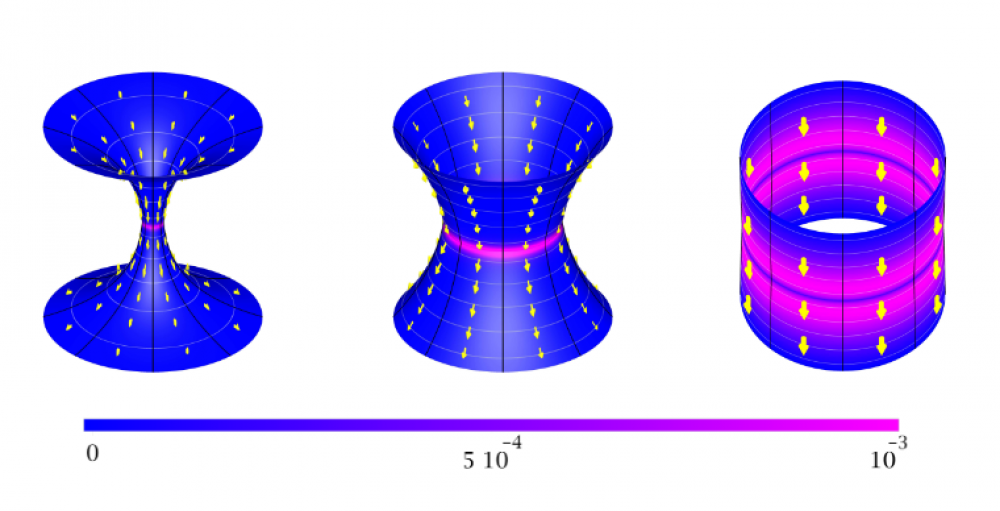
Traversable wormholes are intriguing geometries in General Relativity, which have leaked into science fiction becoming known to the general public. Yet, they typically require exotic matter. In a paper in Phys. Rev. Lett., as Editor's suggestion, Gr@v member E. Radu, together with J. Blázquez-Salcedo (Complutense U.) and C. Knoll (U. Oldenburg), have shown how to construct wormholes in General Relativity without the use of exotic matter (or modified gravity).
Our group coordinated the "Numerical Relativity and High Energy Physics" IRSES network (2012-2015). Here is a list of the global network meetings organized: