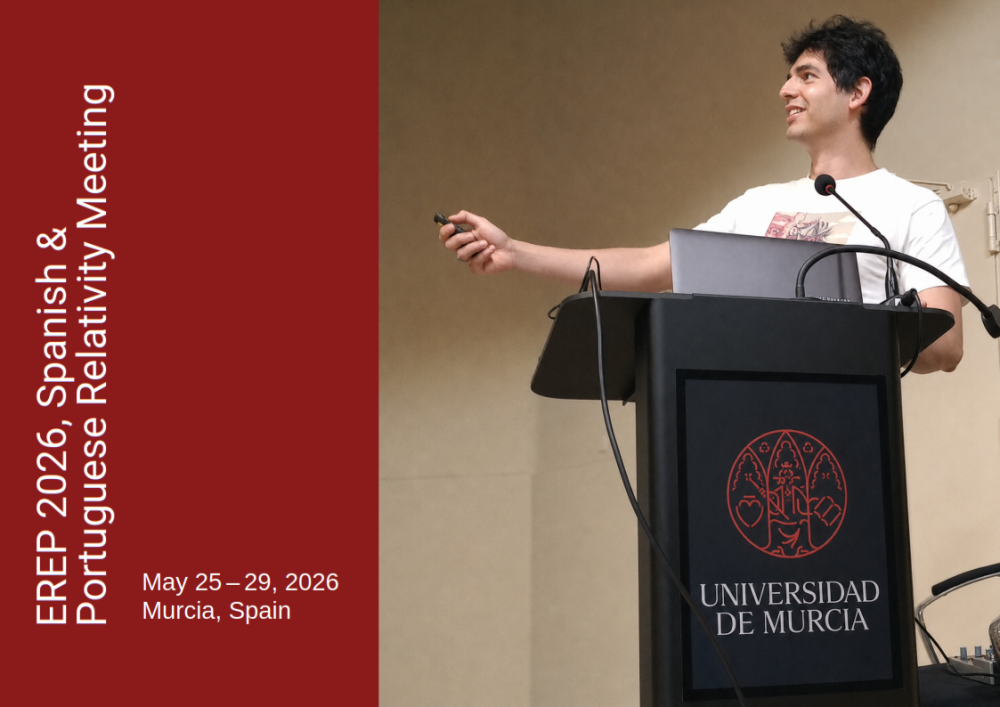
Member of Gr@v H. Olivares participated at the Spanish and Portuguese Relativity Meeting 2026, held in Murcia, Spain, to deliver an invited talk on simulating and observing black hole mimickers.
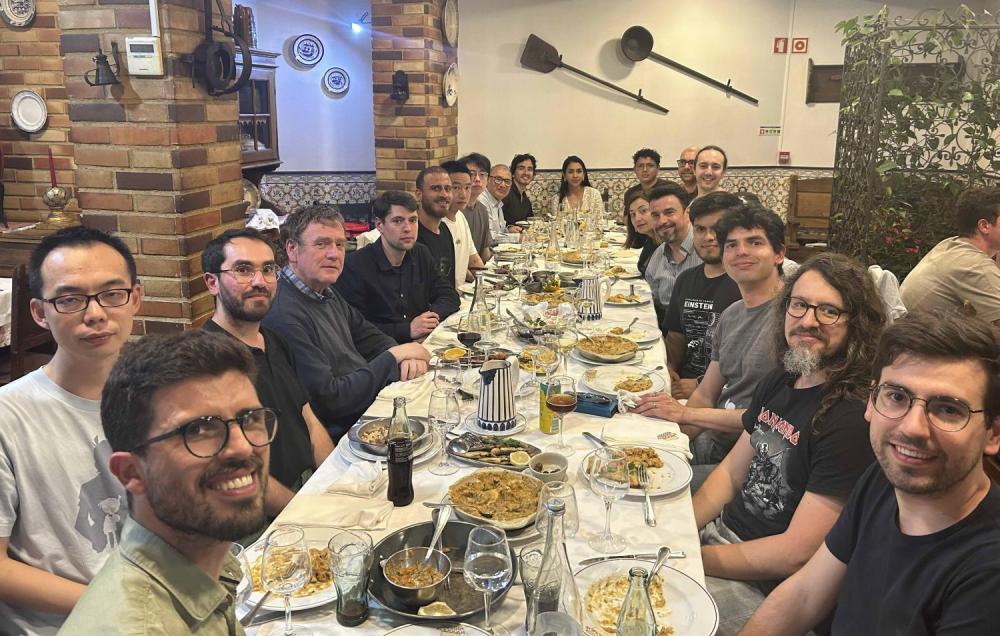
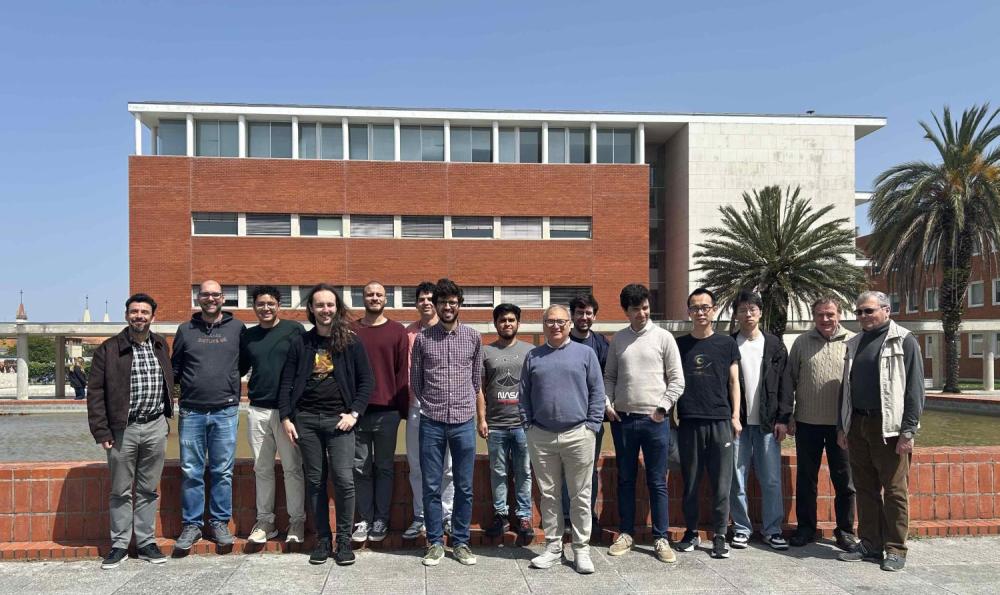
We got together on May 20th 2026 at Etevaldo's favourite restaurant in Aveiro (O Telheiro), to celebrate his 4.5 years in Gr@v. In the same day we had an excellent seminar from Hryhorii Ovcharenko, visiting from Prague. Etevaldo is now starting a post-doctoral position in Brazil. Many thanks, Etevaldo, for being with us. See you soon!
Gravitational-wave (GW) observations have significantly advanced our understanding of stellar-origin compact objects. Current detectors could, in principle, also observe exotic compact objects (ECOs) acting as black-hole mimickers and interacting only gravitationally with visible matter.
Neutron stars offer unique natural laboratories for probing the interaction between dark matter and baryonic matter — a central open question in modern astrophysics and high-energy physics. In this talk, I will present our recent work modeling dark matter as an ultralight bosonic field that accretes onto neutron stars, forming composite objects — fermion-boson stars — bound through gravity.
In April 2026 we received the visits of Maryem Jemri (Rabat) and Justin Feng (Prague). Thank you for your seminars and the great scientific interactions!
Gr@v is hosting the visits of Yasha Shnir, long time group collaborator, under an FCT mobility grant, and Mario Luciano Navarro, Ph.D. student from Valencia in the spring 2026. In the photo Yasha and Mario enjoy a bit of sunshine after the weekly group lunch.
Our group coordinated the "Numerical Relativity and High Energy Physics" IRSES network (2012-2015). Here is a list of the global network meetings organized: