CHARYBDIS2
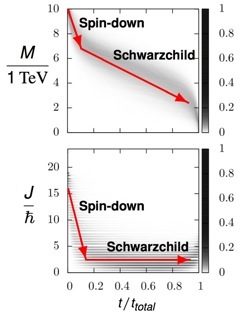
An example of the average evolution of the angular momentum and mass of 10TeV black holes generated with charybdis2. The spread in the point density plots illustrates the statistical fluctuations in the generator.
In models with extra dimensions, the scale of strong gravity can be lowered to LHC energies (1TeV). Then the production of microscopic black holes is possible. According to Hawking, they evaporate in a tiny fraction of a second, emitting in the decay a large number of particles in a very democratic fashion (all Standard Model particles are allowed).
These scenarios are now under scrutiny at the CERN Large Hadron Collider (LHC), planned to run at high energies (as to probe this scenario in the theoretically understood regime) by 2014.
Understanding this phenomenon in detail requires a combination of several layers of physics, such as high energy collisions in general relativity, quantum field theory in curved spacetime, the Standard Model of particle physics, its extra dimensional extensions and ultimately the yet unknown unified theory of general relativity and quantum mechanics -- quantum gravity.
I’m involved in the development of an event generator charybdis2 with members of the Cambridge SUSY working group, where we try to implement all the physics which is understood, so far, in this process (mostly the evaporation and production). This allows for phenomenological studies [1,2] of the feasibility of observing such events at the LHC.